
Private trip
A journey tailored to your dates, your pace, and your group’s needs.
Contact Us ↗Mongolia
Your own musher: glide for seven days deep in the wild Khentii massif.
From 2 920 € per person ↓See the ItineraryKhustai National Park→Ulaanbaatar — airport
Khustai National Park
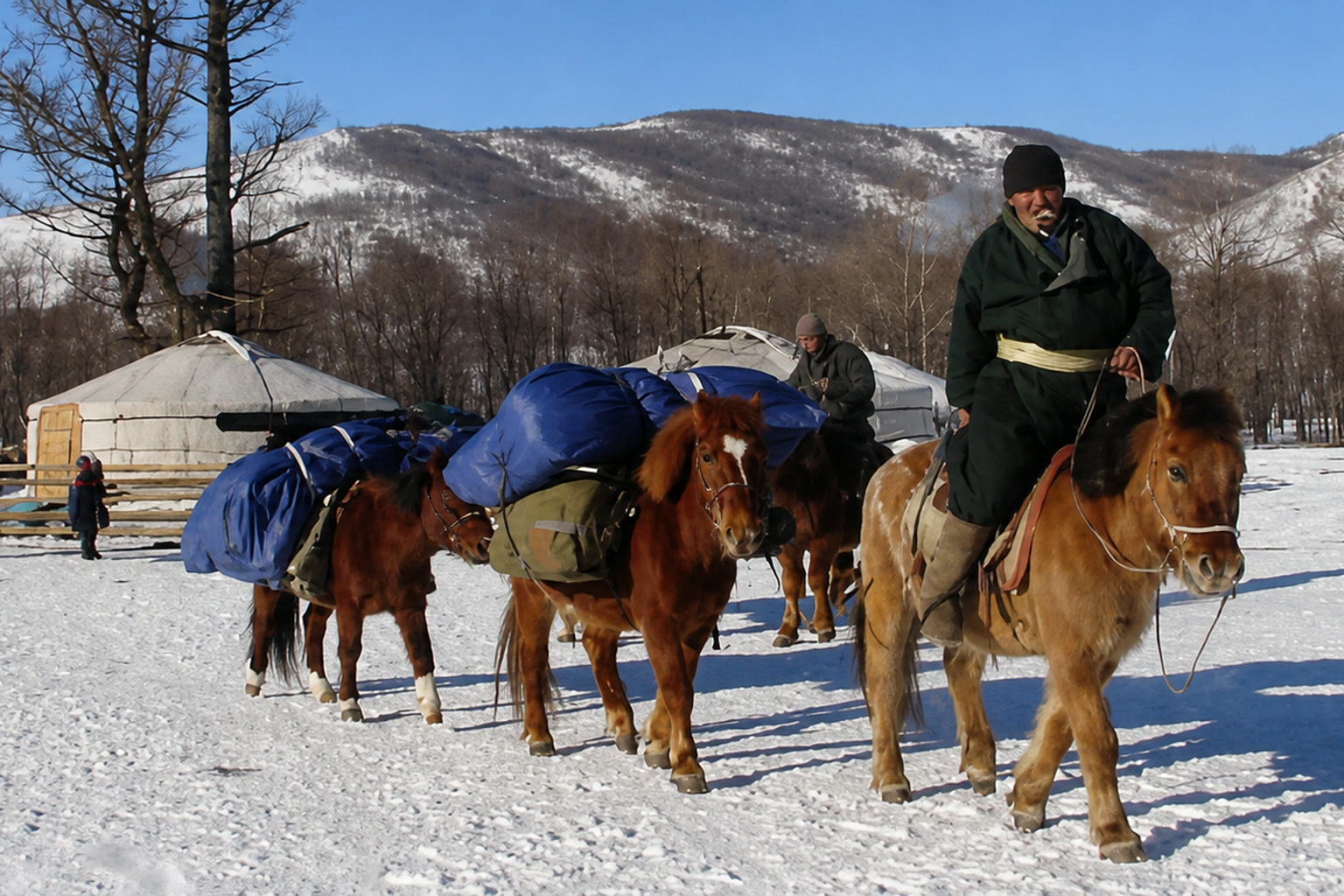
Meet at the airport, then head to Khustai, a national park created around the reintroduction of the Przewalski's horse. The winter steppe is also home to deer, gazelles, wolves, and many bird species.
You will be greeted at the airport by our team before heading straight out of the city to Khustai National Park. Khustai National Park: Khustai is located 80 km from the capital Ulaanbaatar, on the road to Khogno Khan and Kharkhorim, the country’s former capital. The Mongolian government designated Khustai as a specially protected national park in 1993, a year after the Takhi reintroduction project began at Hustain Nuruu. The park encompasses part of the Khentii Mountains and a vast stretch of western Mongolian steppe. Covering 50,600 hectares, it is home to more than 400 species of plants and lichens.
Here, 44 mammal species live—including red deer, Mongolian gazelle, roe deer, wild boar, wild sheep, ibex, Mongolian marmots, grey wolves, lynx, wild cat ('Pallas’ cat'), red fox, steppe fox ('Corsac'), and more. Over 200 bird species can be found, including golden eagle, bearded vulture, great bustard, swan, black stork, partridge, and owl.
In the park’s water points, there are about fifteen fish species and, of course, various amphibians. The diversity of biotopes provides habitat for a multitude of insects—including a recently identified one: Epidamaeus khustaiensis.
Overnight stay in a yurt camp at the park entrance
Terelj base camp
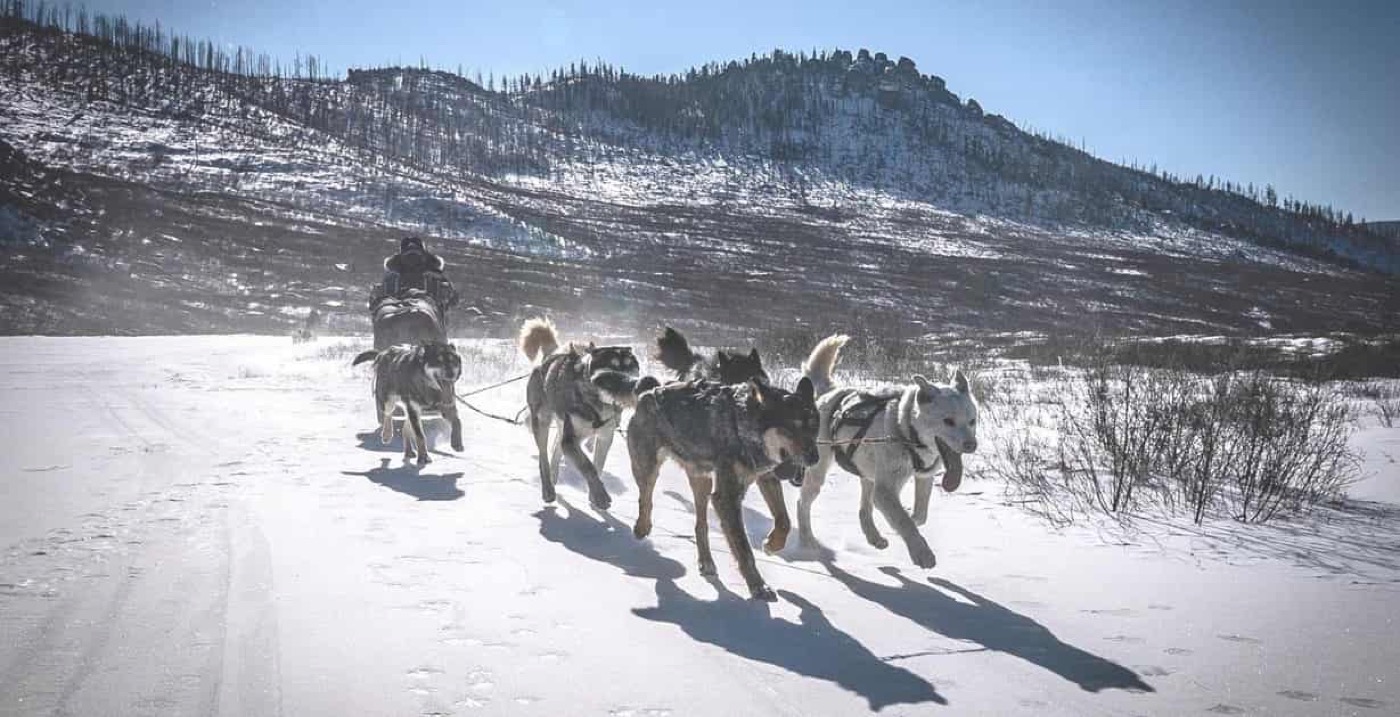
Depending on timing, one last outing in the park is possible before hitting the road. The afternoon takes you to the Terelj base camp, where the team prepares the sleds and equipment.
Depending on timing, you’ll have another chance to venture into the park for wildlife viewing before heading to the capital and then on to our base camp at Terelj.
Arrival at the Terelj base camp. In the afternoon, drive out to our Terelj base camp. Free time for a walk in the area. Untamed nature and nomads…before retreating to the warmth of the yurt. At sunset, temperatures drop quickly—after 4 p.m., the comfort of a yurt is a welcome sight.

Confluence of the Terelj and Tuul rivers
After a few kilometers by vehicle, everyone takes charge of their own sled team at the confluence of the Terelj and Tuul. The frozen river leads all the way to the hamlet of Bosgiin Guur, among the nomad families’ winter camps.
Itinerary along the Tuul River.
Setting off for 7 days of dog sledding—don’t forget anything at base camp…double-check everything…and off we go!
For the first few kilometers, we’ll follow the Terelj River by vehicle before reaching the starting point, at the junction where the Terelj and Tuul rivers meet.
We’ll then continue along the Tuul, heading up the valley towards Khagiin Khar Nuur (Black Lake of Khagiin).
Several nomadic families live in this valley. Wildlife is never far away, and the cold-silenced landscape creates an almost surreal atmosphere.
The ice on the Tuul River is surprising and ever-changing: blue one day, it can darken to black; cracks beneath the skates are audible, making strange sounds…
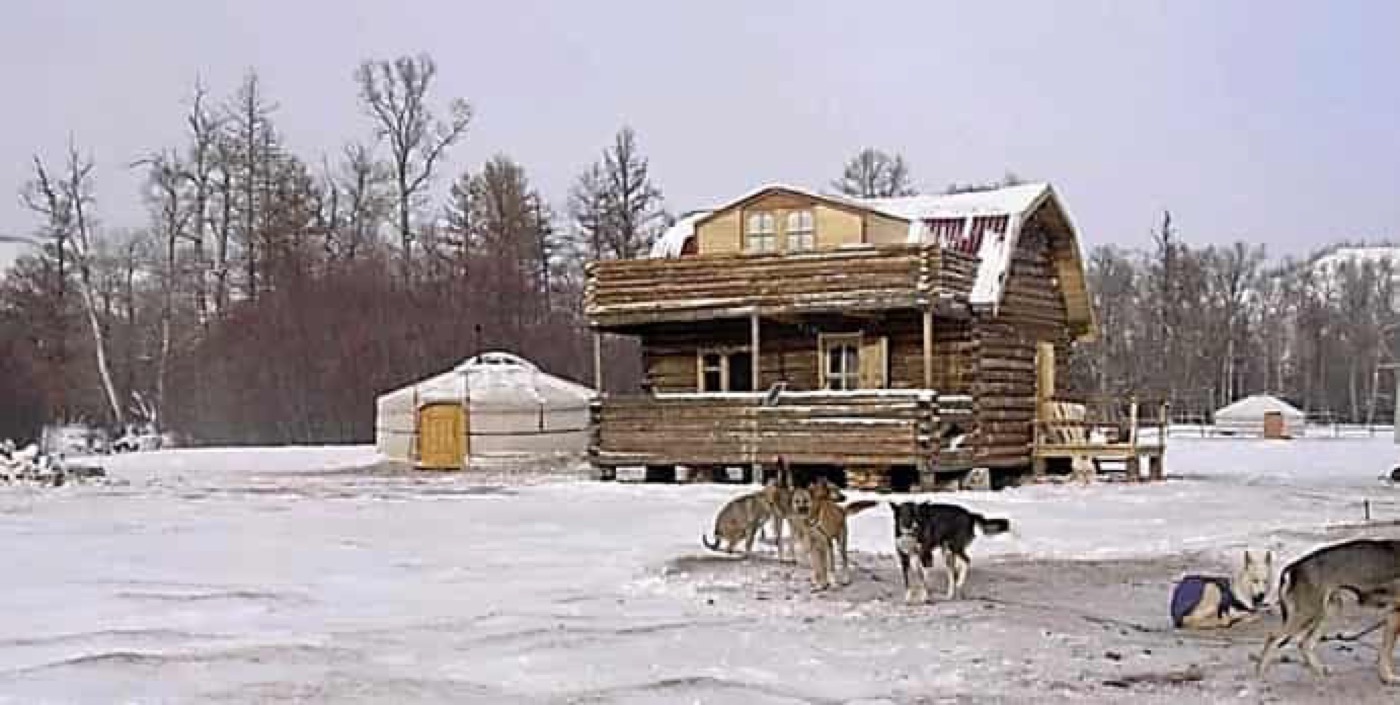
Sometimes, river water seeps through the cracks and forms small open-water lagoons on top of the ice. In winter, Nature truly reigns here. We reach Bosgiin Guur for the night, a small hamlet, home to a handful of families including Enkhtaïvan and Mungoo. We’ll spend the night in their little wooden cabin.
Nomads stay in place all winter and build wooden shelters at their winter camps to shield the herd from wind and cold. In spring they move closer to the water, only to return to the same spot the following winter. It’s a cyclical migration.
Sharing moments under the yurt with the nomads is an unforgettable experience.
Discover a different culture, one that harmoniously blends tradition and modernity.

Khar Us — upper Tuul valley
The Tuul becomes calmer and splits into long meanders before reaching Khar Us. Tsodoo and his family welcome the group at one of the last inhabited camps in the valley.
Set off for Khar Us. Along this route, the Tuul River grows calmer, splits into several branches, then vanishes into endless meanders. After a picnic stop, we’ll reach the Khar Us camp (the black waters) by mid-afternoon.
There live four or five families grouped together to better face the harshness of winter.
We’ll be welcomed by Tsodoo and his family to spend the night in the yurt.
This is one of the last camps in the valley; then, only a single family has set up their winter camp a few kilometers further upstream, and after that… only wildlife is left to haunt these stunning places.
The comfort of a guest yurt, which Tsodoo and his wife have set up right next to their own.

Confluence of the Tuul and Khagiin
The landscape becomes more barren and wild as the route heads towards the Khagiin. After about forty kilometers, a small yurt carried by horses is set up at Tsakhiir Chuluu for the bivouac.
Today’s stage will take us into a rockier part of the mountains, always getting closer to the black lake of Khagiin.
The landscape becomes ever wilder, reminiscent of Alaska.
There are no nomads in these parts anymore, but it’s not unusual to meet riders crossing these mountains from one valley to another.
A 40-kilometer stage to reach the junction of the Tuul and the Khagiin, then we’ll continue a bit further along the Khagiin Gol to reach Tsakhiir Chuluu… just a name on a map… but that’s where we’ll set up camp.
A place of breathtaking wild beauty…
Tsodoo or Azaa will be waiting for us somewhere on the riverbank; he’ll likely have the stove lit already… Overnight in the yurt.
....The yurt:
A small yurt designed to be very easy to transport and take up little space. Just three horses are enough to carry it.
Inside, a small stove—perfect for cooking and for spending a cozy, warm night.

Khagiin Khar Nuur
The river becomes a mountain torrent before widening into the remote Khagiin Khar Nuur lake. Picnic by the frozen water, tracking animal prints, then return to the Tsakhiir Chuluu camp.
We’ll follow the Khagiin Gol even higher, as it turns from a placid river into more of a mountain torrent… breathtaking scenery, leading us to a kind of open plateau.
Winding along the meanders or cutting through the trees, we reach Lake Khagiin Khuul Nuur just in time for a picnic. This is one of some twenty lakes in the Khentii range…
It used to be rare to see travelers in this corner—the only ones coming so far into the mountains were a few diehard ice fishermen or pine cone foragers.
In this true wilderness live elk and musk deer, but you’ll need luck to spot them—even if they’re never far away, just like the wolves or wolverines…
We return to camp in the middle of the afternoon, where the team will be waiting for us.
Preparing soup for the dogs, chopping wood… and finally sipping a good hot tea…

Tsakhiir Chuluu — Khar Us
The expedition leaves these remote landscapes to rejoin Tsodoo’s camp. The evening in the yurt is a time to reconnect with the hosts and gradually return to the inhabited valley.
It’s always hard to leave these remote corners of the world…
But we’ll set off again for Tsodoo’s camp.
Night in the guest yurt at Tsodoo’s.
A festive evening under the yurt!!!
+30°C inside & -30°C outside!!

Bosgiin Guur — Tuul valley
A stage of about thirty-five kilometers follows the Tuul downstream. Wolf tracks, changing light, and landscape details reveal themselves differently along this familiar route in reverse.
A 35-kilometer journey to reach Enkhtaïvan’s camp, further down the valley. The dogs are always eager to run on the ice, utterly fearless, sniffing wolf tracks here and there.
To get back to the camp, we follow the same route as before, along the river. This gives us the chance to observe even more: the tracks, the landscape…
Enkhtaiven and Mungo are retired and have settled in this tiny hamlet, Bosgiin Guur, home to three or four herding families.
We settle into the guest yurt set up next to the log cabin where the couple lives.
At Mungoo’s, as they say, the mood is always cheerful. As soon as we arrive, our hosts get right to work, cooking up a hearty meal to charge our batteries…
Bosgiin Guur — Terelj
Last kilometers on the Tuul to its junction with the Terelj, where vehicles and trailers await. The base camp is reached by afternoon after one last meeting with the nomadic families.
Departure from Bosgiin Guur.
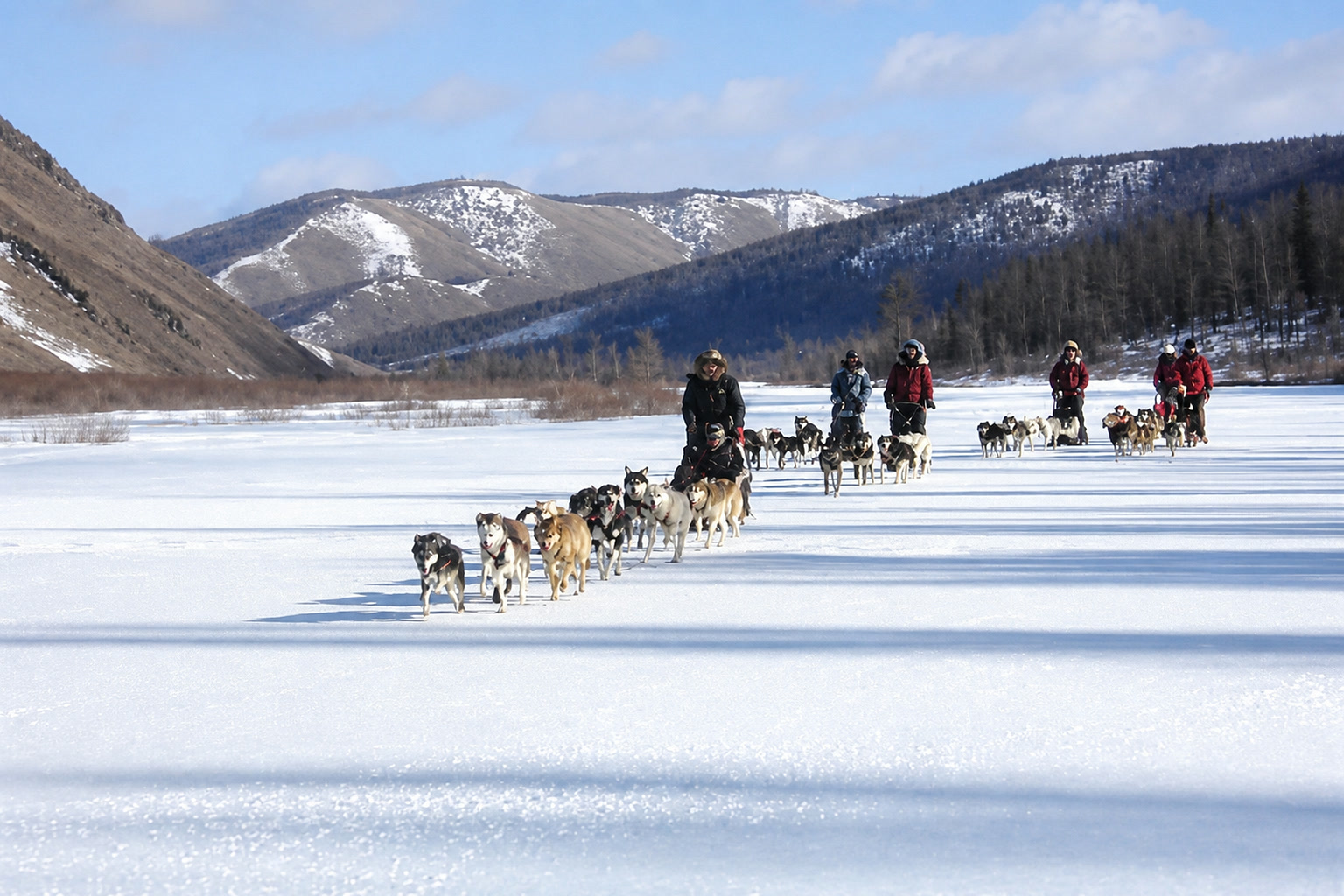
Once again, we glide over the Tuul to its junction with the Terelj. Just a few more kilometers to reach our end point, where vehicles and trailers are waiting for us.
The last sled moments and the final exchanges with the nomads.
Arrival at Terelj base camp in mid-afternoon.
Overnight at Terelj base camp.
Ulaanbaatar
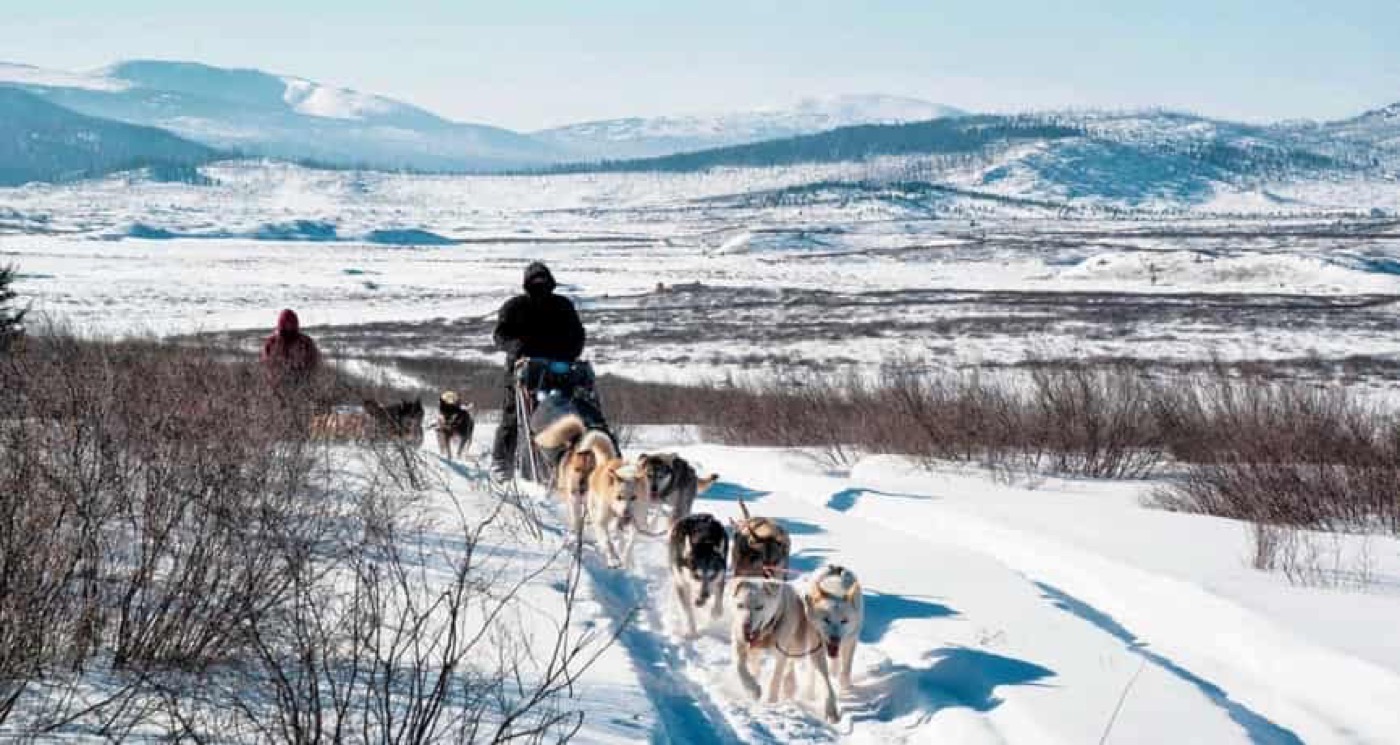
Transfer from Terelj to the capital, check-in at the hotel, then free time for the large market or some last-minute shopping. A dinner in town marks the end of this seven-day sledding adventure.
Transfer from Terelj to Ulaanbaatar. Check-in at the hotel.
Shopping in town or at the main market.
Dinner in the city
Ulaanbaatar — airport
Morning transfer to the international airport. The journey ends after an immersion in the frozen valleys of Khentii and the life of winter camps.
From Terelj, this expedition follows the frozen Tuul and Khagiin rivers all the way to the remote Khagiin Khar Nuur lake. Each traveler drives their own dog team for seven days.
The trip alternates between gliding along the river, camping in lightweight yurts, wooden cabins, and stays with nomad families. Days are spent learning to harness, drive, and care for a team of five to six dogs.
You will visit
The dry cold can reach about -20°C during the day and -30°C at night. Simple comfort is required, and you’ll need to take part in expedition life and stay flexible in changing ice and snow conditions.
The price shown is indicative, per person. Listed departures are available on request and are confirmed with Gilles before any booking is made.
Don’t miss
Autonomous and healthy travelers, ready to choose immersion, effort, and expedition living over conventional comfort.
Extreme cold, daily sled driving, 35–40 km stages and a longer loop to the lake. Rustic nights and active participation in camp life.
Scheduled departures in January and February.
Group of 2 to 4 participants, one person per sled.
Each team generally consists of 5 to 6 dogs.
Mushing equipment is provided; you will receive a detailed cold-weather clothing list before departure.
Included in the quote
Not included
Upcoming departures